
Europe’s security landscape is changing faster than at any point since the Cold War ended. As NATO strengthens its Eastern Flank—from the Arctic Circle, through the Baltic states, and down to the Black Sea—one thing has become clear: speed is no longer a theory, it’s a necessity.
In today’s security environment, deterrence isn’t just about how advanced your aircraft are. It’s about how quickly you can deploy them, protect them, and keep them operational. Strategic Speed—the ability to move, build, and adapt fast—has become a decisive factor in modern air power.
The End of Waiting Years to Build
For decades, military infrastructure followed a familiar pattern: permanent buildings, long planning cycles, and construction timelines measured in years. Traditional steel or concrete aircraft hangars required heavy foundations, complex logistics, and massive on-site labor.
That model no longer works.
Modern threats don’t wait for concrete to cure. If fifth-generation aircraft like the F-35 or F-16 need to be deployed forward—quickly and unpredictably—there is no time for an 18-month construction schedule. Static infrastructure has become a strategic liability. Fixed bases are visible, predictable, and permanently marked on an adversary’s map.
What today’s commanders need is infrastructure that can move as fast as their mission.
This is where Sprung structures, delivered by Kinematika Systems, change the equation.
Fast Doesn’t Mean Fragile
There’s a common assumption that rapid deployment comes at the cost of durability or performance. In military aviation, that assumption simply isn’t acceptable.
Modern combat aircraft are more than machines—they are flying supercomputers. Their avionics, stealth coatings, and maintenance requirements demand tightly controlled environments: airtight, climate-stable, and structurally robust.
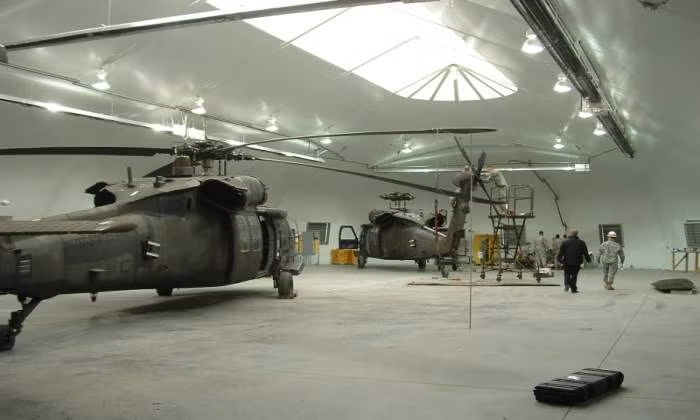
Sprung hangars deliver exactly that. Their patented tensioned membrane system creates a continuous, airtight envelope—critical for humidity control and long-term aircraft protection. High-performance fiberglass insulation ensures stable interior conditions, whether the hangar is operating in the icy winters of Estonia or the humid summers of Romania.
The result? Permanent-building performance, without permanent-building delays.

How Speed Is Engineered
So how can a full-scale aircraft hangar be operational in weeks rather than years?
The answer lies in smart engineering and logistics. Sprung’s aluminum substructure is significantly lighter than steel, allowing entire hangars to be shipped efficiently in standard containers. This dramatically reduces pressure on military transport networks.
On site, everything is designed to move fast. The structures use a bolt-together system—no field welding, minimal heavy machinery, and no need for massive concrete foundations. Hangars can be installed directly on existing aprons or compacted gravel using specialized earth anchors.
What traditionally takes 18 months can now be achieved in less than 30 days.
Mobility as a Strategic Advantage
Within NATO’s Enhanced Forward Presence, flexibility isn’t a bonus—it’s a force multiplier. A Sprung hangar isn’t a fixed asset; it’s a relocatable one.
If operational priorities shift, these hangars can be dismantled, transported, and reassembled elsewhere without loss of structural integrity. That means air power can surge where it’s needed most—without leaving behind wasted infrastructure or locking forces into predictable patterns.
This mobility keeps adversaries guessing and allows airfields themselves to become part of the maneuver.
Designed for the People Behind the Aircraft
Speed and readiness don’t depend on aircraft alone—they depend on the people who maintain them.
Working outdoors in freezing temperatures, heavy rain, or extreme heat reduces efficiency and increases the risk of errors. Sprung hangars create a controlled, well-lit, and comfortable environment where crews can focus on precision work.
Translucent daylight panels flood the interior with natural light, reducing eye strain and energy consumption. The clear-span design—up to 60 meters wide—means no internal columns, allowing unrestricted movement of aircraft, ground equipment, and personnel.
Better conditions mean faster turnaround times, higher morale, and safer operations.
Building for the Mission Ahead
As European defense spending rises and readiness timelines shorten, infrastructure must evolve alongside modern aircraft and doctrine. Speed, adaptability, and resilience are no longer optional—they are mission-critical.
Kinematika Systems is committed to supporting NATO and its partners with infrastructure that matches the pace of modern defense operations.
Because in today’s security environment, we don’t just build hangars.
We build Strategic Speed.
https://www.nato.int/en/news-and-events/articles/news/2025/09/12/nato-launches-eastern-sentry-to-bolster-posture-along-eastern-flank?utm_source=chatgpt.com
https://www.nato.int/en/what-we-do/deterrence-and-defence/strengthening-natos-eastern-flank?utm_source=chatgpt.com